
What is the city doing to protect Nanaimo’s water supply?
From concrete pipes that can catastrophically fail to holes in the South Fork dam that could empty the reservoir within days, here’s how the City of Nanaimo is working to reduce the risk to residents.
The next time you pour yourself a glass of water, boil a pot of water for cooking, or step into the shower imagine that no water came out of the tap when you turned it.
Every moment you open the tap, you are relying on roughly 700 kilometres of pipe maintained by city staff to get you the clean water you rely on.
The city’s engineering and public works 2025 business plan estimates that about six per cent of the pipes are near the end of their useful life and require “heightened monitoring and eventual replacement.”
With high profile water main breaks in Calgary and Montreal, the City of Nanaimo is working to get ahead on critical infrastructure replacements for a known offender: concrete pressure pipe.
“It’s a very catastrophic pipe. When it does rupture, it can cause significant damage,” Mike Squire, the city’s manager for water resources, told the city council’s governance and priorities committee on May 11.
Squire presented a five-year capital plan to Nanaimo City Council that could prevent a “catastrophic failure” of critical water supply infrastructure.
A major watermain break in the city could blow out large sections of pipe that quickly drain reservoirs and interrupts water supply for both residents and firefighting, Squire told The Discourse.
If just one of three leaking 24-inch culverts in the South Fork Dam fully breach it could drain the city’s water supply within days, leaving residents and fire services dependent on limited untreated water pumped in from Harmac Pacific that would put the entire city on a boil-water advisory with strict water restrictions.
Squire said that the city is in good shape to address the risks that have been identified and a plan is in place to ensure that Nanaimo has enough clean water to quench the thirst of residents as the population and industry grow over the next 20 years.
“We’re trying to build a resilient water supply system, so if any of these events — whether it be climate change, an earthquake, or a [water main] break — [happen] the city has ways and means to convey water fully to the community, so we won’t be in a position where the city is out of water,” he told The Discourse.
Nanaimo’s past experience with water main breaks
In April 2020, the water main on Bowen Road suffered a major break draining three reservoirs and leaving the Nanaimo Regional General Hospital without running water.
“I don’t believe this community can afford the hospital to be out of water,” Squire said recalling the 2020 break.
The spill of 22 million litres of water caused an estimated $250,000 in damages to local homes.
The type of pipe used for that water main and others in the city are constructed out of concrete and when they break the result can be catastrophic.
Similar pipes in Calgary suffered major breaks in 2024 and again earlier this year. Last week, a water main break in Kamloops left 8,000 households without water for 36 hours.
A major barrier for the City of Kamloops getting information about the water main break out to residents was that people had not signed up for its free emergency alert system, known as Voyent Alert.
Evan Lloyd, emergency manager at the City of Nanaimo, said that people should sign up for the Voyent Alert System, which provides local emergency alerts from the city as well as the Regional District of Nanaimo.
In response to the water main break on Bowen Road, the city undertook a major upgrade to the midtown water supply system that was completed in 2024.
The work included laying both a new primary transmission watermain that delivers water from the College Drive reservoirs to the Labieux Road water station. It also included a new secondary transmission watermain from College Drive to Bowen Road and Pryde Avenue. It also built a dedicated supply main for the Nanaimo Regional General Hospital.
Squire told the committee that the work on the midtown water supply means that the Vanderneuk reservoir and Rutherford Road supply main projects in North Nanaimo can be deferred to address more critical issues in South Nanaimo.
Emergency response in the event of a major water main break
In the event of a major incident in Nanaimo, the city’s emergency operation centre will be activated helping coordinate the response by different city departments as well as provincial and federal authorities.
Lloyd told The Discourse that the city maintains emergency management capability at all times and is ready to respond to a wide range of emergencies from disruption of the water supply, to wildfires and major earthquakes.
What the response could look like for a disruption of the water supply would depend on the nature of it and how long it could last, but would involve support from the province.
Lloyd said that his department would look at the responses from previous incidents in other communities, such as Calgary, to learn lessons and best practices.
The emergency management operations centre would bring the experts from different areas responding to a situation together to make decisions “that are as agile and knowledgeable as we can,” Lloyd said.
Lloyd said that before the South Fork Water Treatment plant was completed in 2007, boil water advisories in the city were more common and that the high-tech facility plus Nanaimo’s large water supply gives the city a “strong resilience.”
Lloyd suggests that residents be prepared to shelter in place for several days and also be ready to evacuate if needed with an emergency kit prepared with at least seven days worth of supplies in the event of an emergency.
Concrete pipe along above Nanaimo parkway slated for replacement
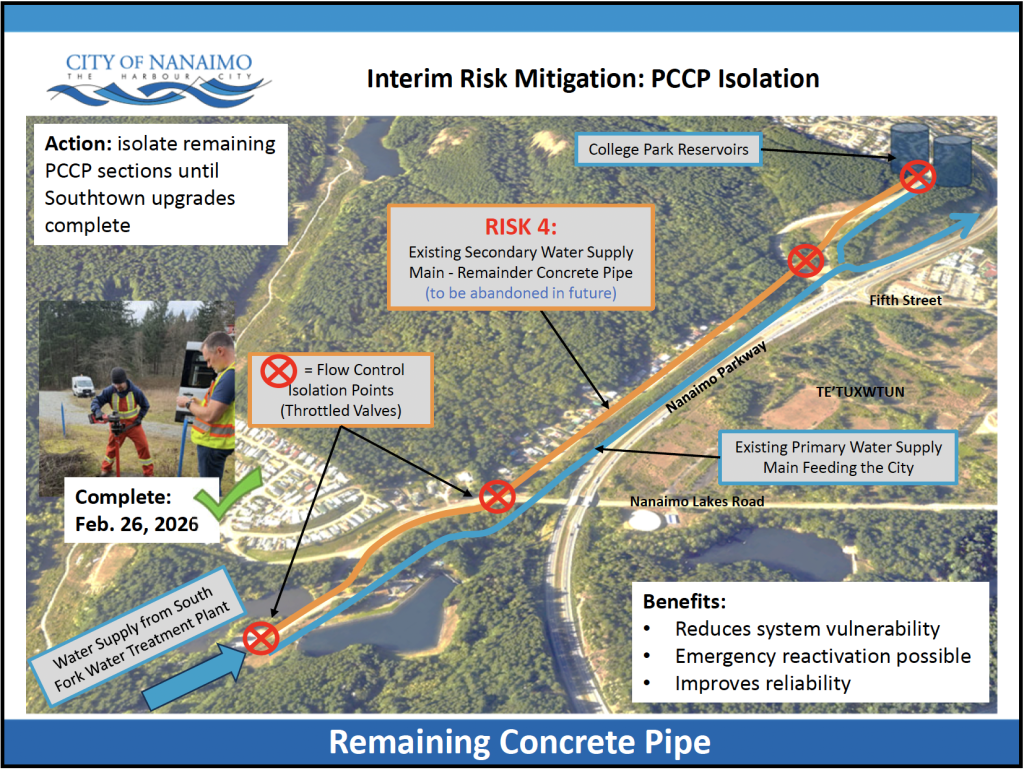
Squire told council that the secondary water supply main coming into the city from the College Park reservoirs on Dogwood Road above the Nanaimo Parkway is constructed with the same type of concrete pipe that failed on Bowen Road.
In response to the risk of a water main break along the parkway, the city has throttled the valves along the pipe to isolate the sections.
“So if it does break, or pardon me, when it breaks, it will be a flow equivalent of a fire hydrant being open” Squire said, estimating that it will take five years to replace the pipe.
There is also a bottleneck of water supply in the south end where demand for water is projected to exceed capacity within five years.
The city would like to replace the existing connections off the main supply line with a parallel distribution main that will support new developments including the te’tuxwtun property on the former site of the Nanaimo Indian Hospital that was added to the Snuneymuxw First Nation’s reserve lands last year.
The project is estimated to cost more than $40 million and will be complete by 2032.
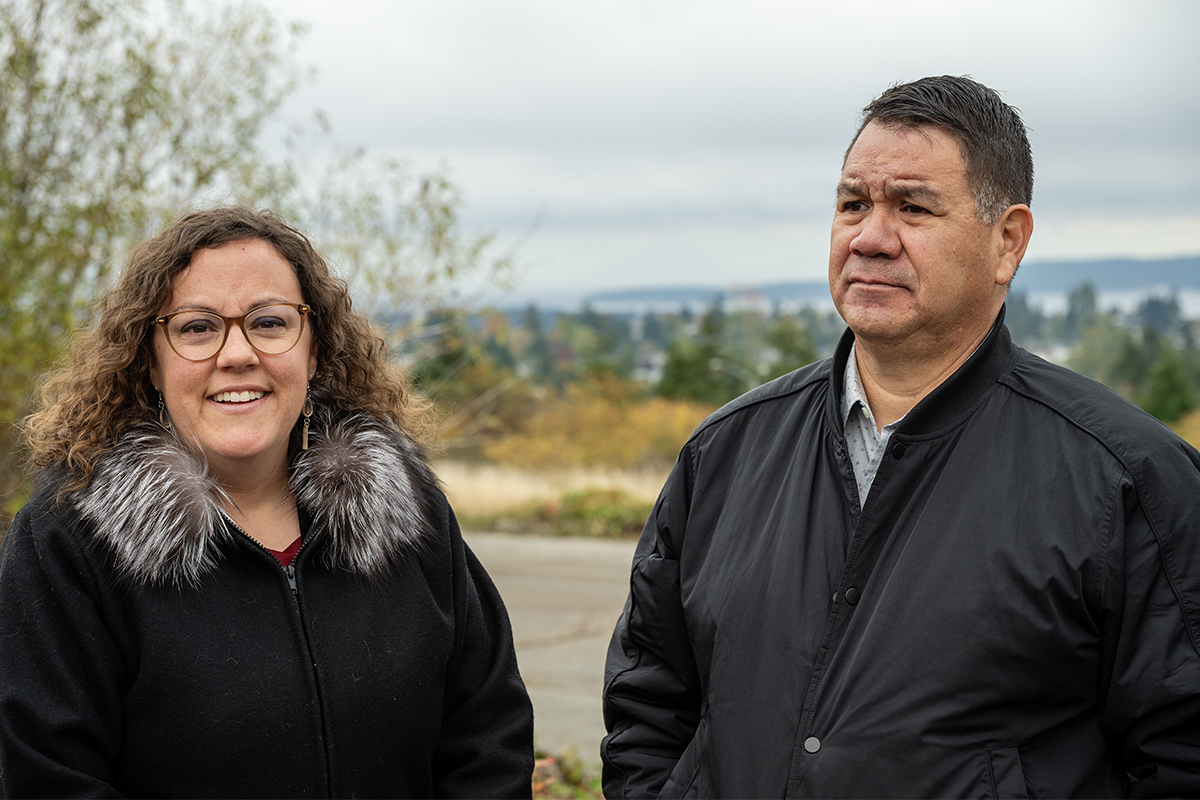
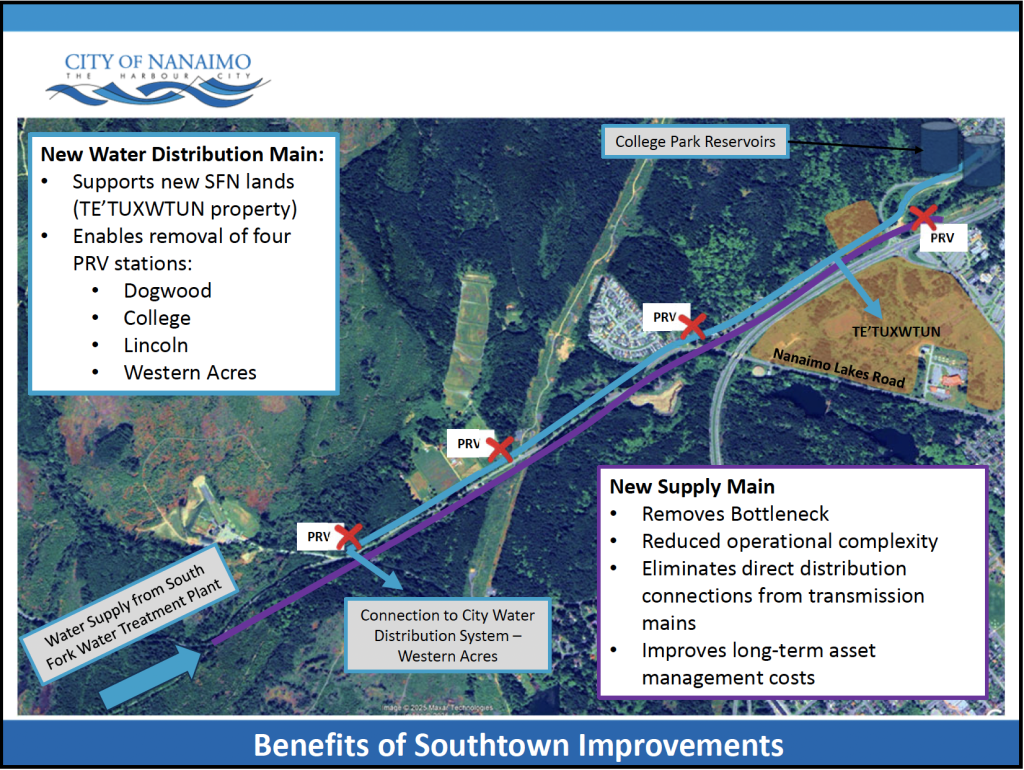
That will create what Squire called “properly gridded network” of water supply from the College Park reservoirs to Western Acres.
If leaking South Fork Dam breaches, city staff ‘don’t know how we could stop it’
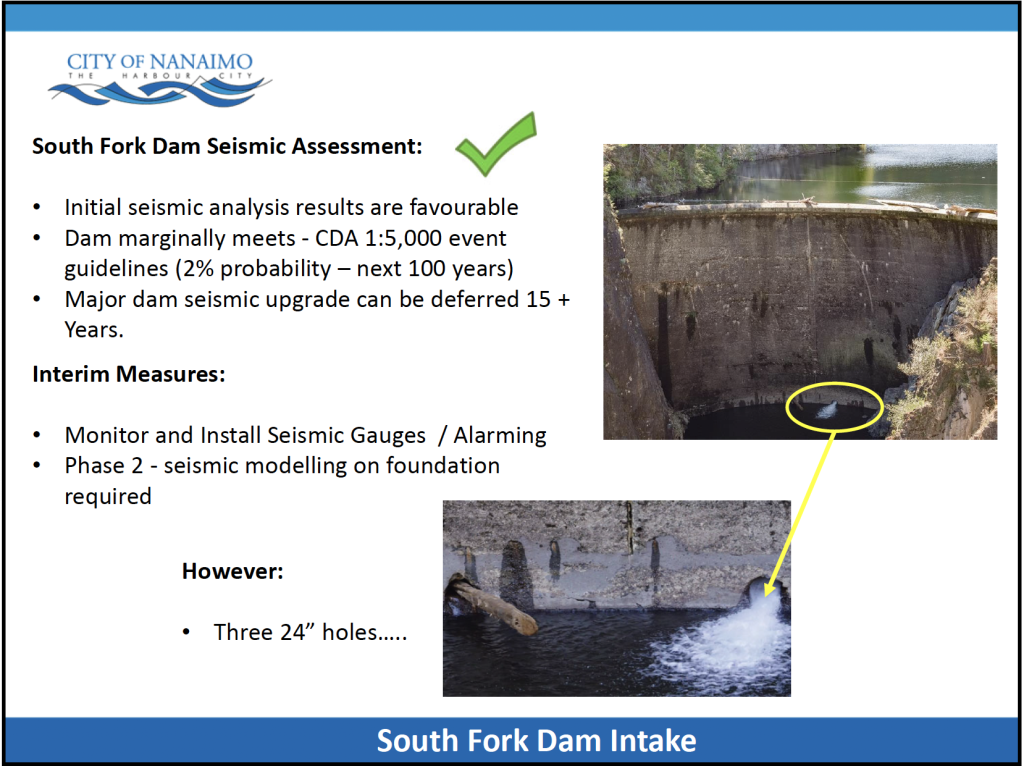
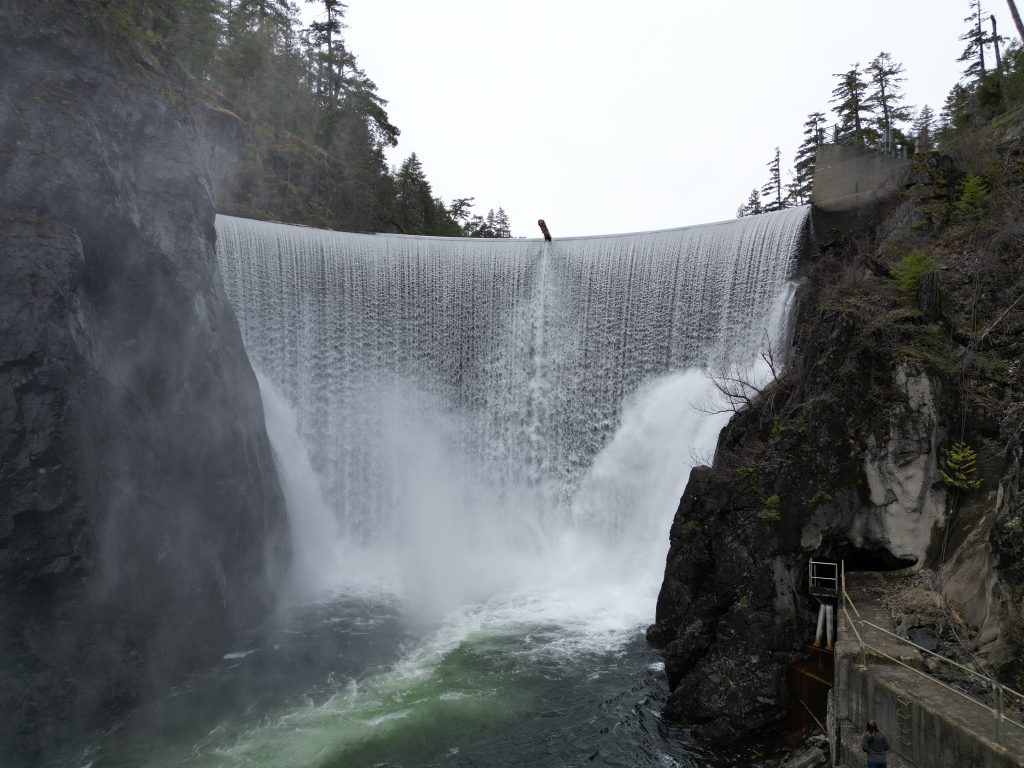
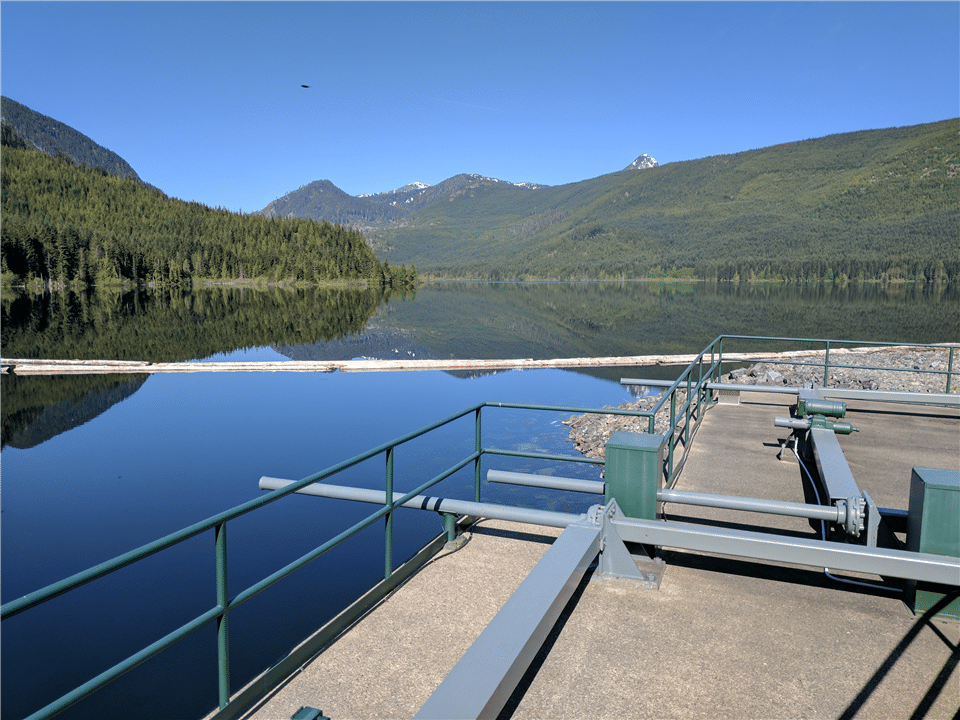
Nanaimo’s South Fork Dam was built in 1931 and is the only water intake into Nanaimo. The water intake pipe from the dam has been in constant use since then and the pipe’s condition has never been assessed.
During construction of the dam there were three 24-inch culverts built into the bottom of the structure so water could continue to flow during construction. Those culverts were plugged with cedar logs and over time have started to leak.
Squire said that debris and sediment has accumulated on the upstream side of the dam making it impossible to see what is currently blocking the culverts and that it is too dangerous for divers to inspect.
“If just one of those 24 inch culverts was to breach and fully flow, the reservoir, our water intake, would be drained within two and a half days,” Squire told the committee. “And quite honestly, I don’t know how we could stop it.”
In the event of a breach at the dam, the city would rely on an agreement with Harmac Pacific to supply untreated water to the city, which would have to be boiled before drinking or cooking. The city would also go on level 4 water restrictions and no outdoor watering would be permitted.
The plan is to plug the holes in the dam in the next three or four years, Squire told the committee.
Upgrading the South Fork Dam to include a second intake and upgrading the raw water main is expected to cost more than $35 million and be completed by 2037, while the South Fork Dam’s seismic upgrades, and the North Nanaimo projects are slated to be finished in 2043 at a cost of more than $70 million.
What did you think of this story?
Your feedback after we publish a story helps ensure we're always improving our reporting to better serve you
Author

Related Articles
Comox Valley, Nanaimo land trusts raising funds to support Deep Bay land conservation purchase
In a partnership with the Comox Valley and Nanaimo Area land trusts, BC Parks Foundation is fundraising to protect 50 hectares of pristine shoreline in Deep Bay and make it accessible to the public.

Nanaimo Jazz Festival celebrates 10 years with more than a dozen shows in September
Local and international artists to perform on multiple stages in the city at this year’s Nanaimo Jazz Festival.

Snuneymuxw Elder C’tasi:a shares traditional plant knowledge in new book
‘Plant Teachings from my Auntie’ by Snuneymuxw Elder C’tasi:a and ethnobotanist Nancy Turner delves into traditional plants and plant medicine.