
The Great Vancouver Island Land Grab exhibit aims to educate
How a 19th century land grant continues to impact First Nations on Vancouver Island.
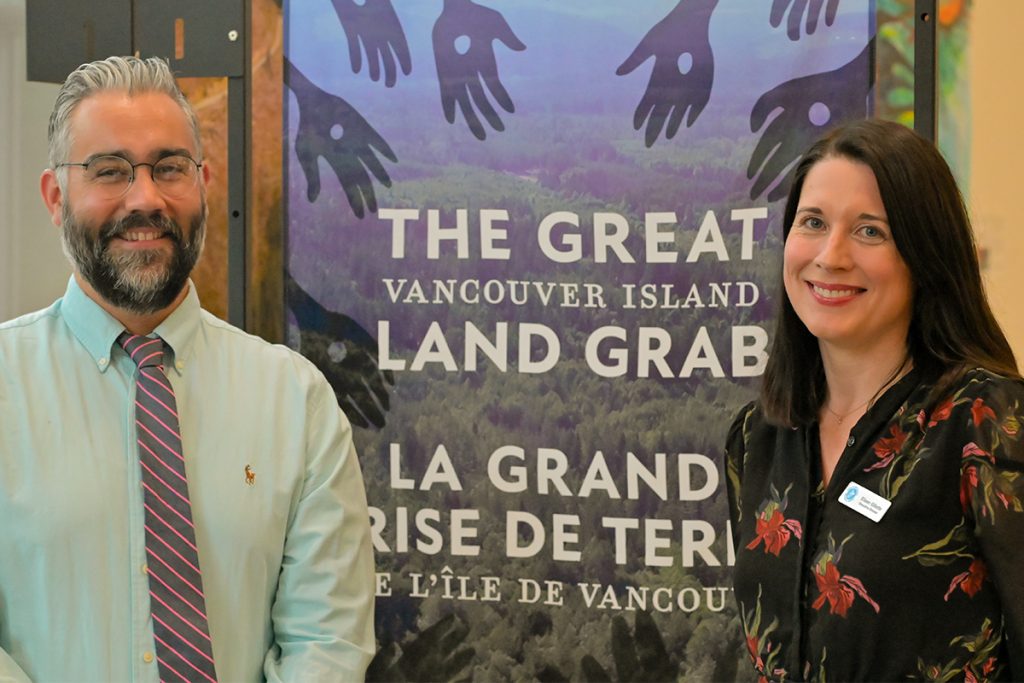
Kelly Black grew up on Quw’utsun lands in Cobble Hill Village across from the tracks of the Esquimalt and Nanaimo railway and a logging equipment yard.
“I literally grew up watching the train go by and seeing the work of extracting logs from these territories, but I never knew about the E&N land grant or the Great Land Grab,” he told a crowd gathered in the Harbourfront Library in downtown Nanaimo.
Black was speaking as the president of the Vancouver Island Local History Society. It recently launched a travelling exhibit on the history of how a large swath of Vancouver Island was taken from Indigenous Peoples and given to private companies in exchange for them building the railway in the late 19th century — the impacts of which are still seen and felt today.
The exhibit is called The Great Vancouver Island Land Grab and is a collaboration with the Nanaimo Museum.
Despite growing up along the tracks, Black didn’t know about the impact of the railway, and the massive land grant that went with it, until he took a history class at what is now Vancouver Island University.
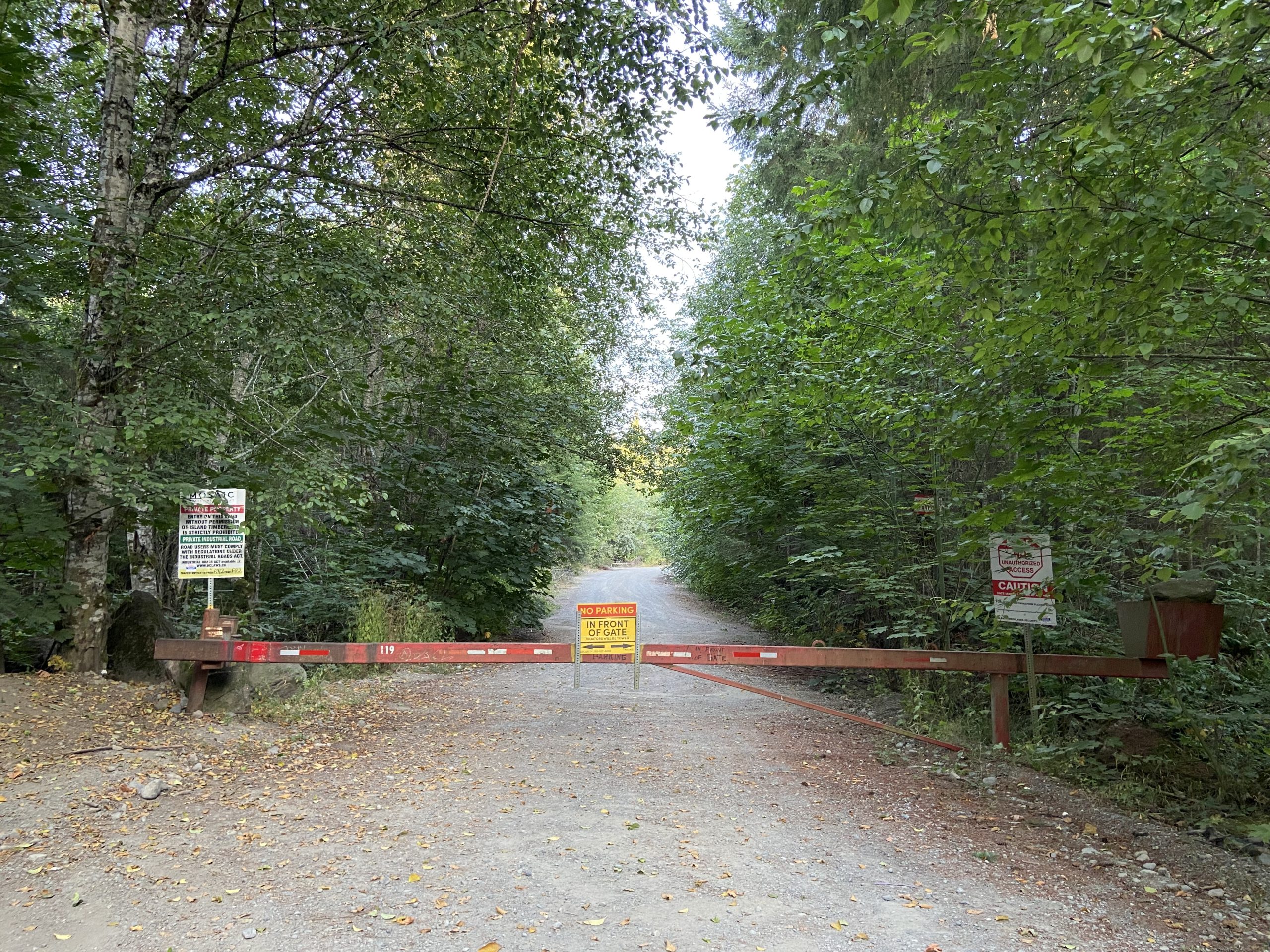
“For the Hul’qumi’num People, they’ve been denied access to these lands,” said Tl’ul’thut (Robert Morales), chief negotiator of the Hul’qumi’num Treaty Group in the exhibit’s opening video. “These forestry companies put up steel gates so that you cannot enter those lands without their permission. You cannot carry on traditional practices without their permission. Economically, they’ve been denied any access to the resources.”
What is the E&N Land Grant?

As part of the deal for the Colony of British Columbia joining Canada in 1871, the federal government promised to build a railway link from the west coast to the eastern provinces.
The government granted enormous tracts of land stretching from what is now known as Victoria to Campbell River to coal baron Robert Dunsmuir as private land in exchange for building the railway. But the land was taken from the territories of several First Nations across the Island.
The land grant covers 8,090 square kilometres, making it larger than Prince Edward Island, Metro Vancouver or the European country of Luxembourg.
The railway and the land grant opened up new communication routes for both colionization of Vancouver Island as well as resource extraction of logging and mining on an industrial scale.
First Nations not consulted or compensated
In the introductory video for the exhibit, Morales said “there was no negotiation, no compensation, no disclosure of what was happening” for First Nations whose territories were included in the land grant.
The land covered in the E&N land grant was not covered by treaties and Morales said the policies of the colonial government did not leave any space for Indigenous land rights.
“They just passed all this legislation, land laws, and effectively said ‘we own British Columbia, and there are no Indigenous land rights,’” he said.
There was a federal law that said First Nations should have been compensated for the land expropriated for the railway but that was ignored.
Morales said the exhibit is timely given the debate about Indigenous and private fee-simple land rights in B.C. following the ruling on a court case by the Quw’utsun First Nations that granted five First Nations land rights for a former village site on Lulu Island in Richmond, B.C.
“You’re hearing a lot about ‘First Nations are going to steal your land, First Nations are going to take your house,’” Morales said. “First Nations are not going to devalue your property. None of that’s going to happen.”
But the question of the private forest lands that have been stolen from First Nations people on Vancouver Island need to be resolved, and Morales said the government refuses to discuss it.
Building the tracks of colonialism
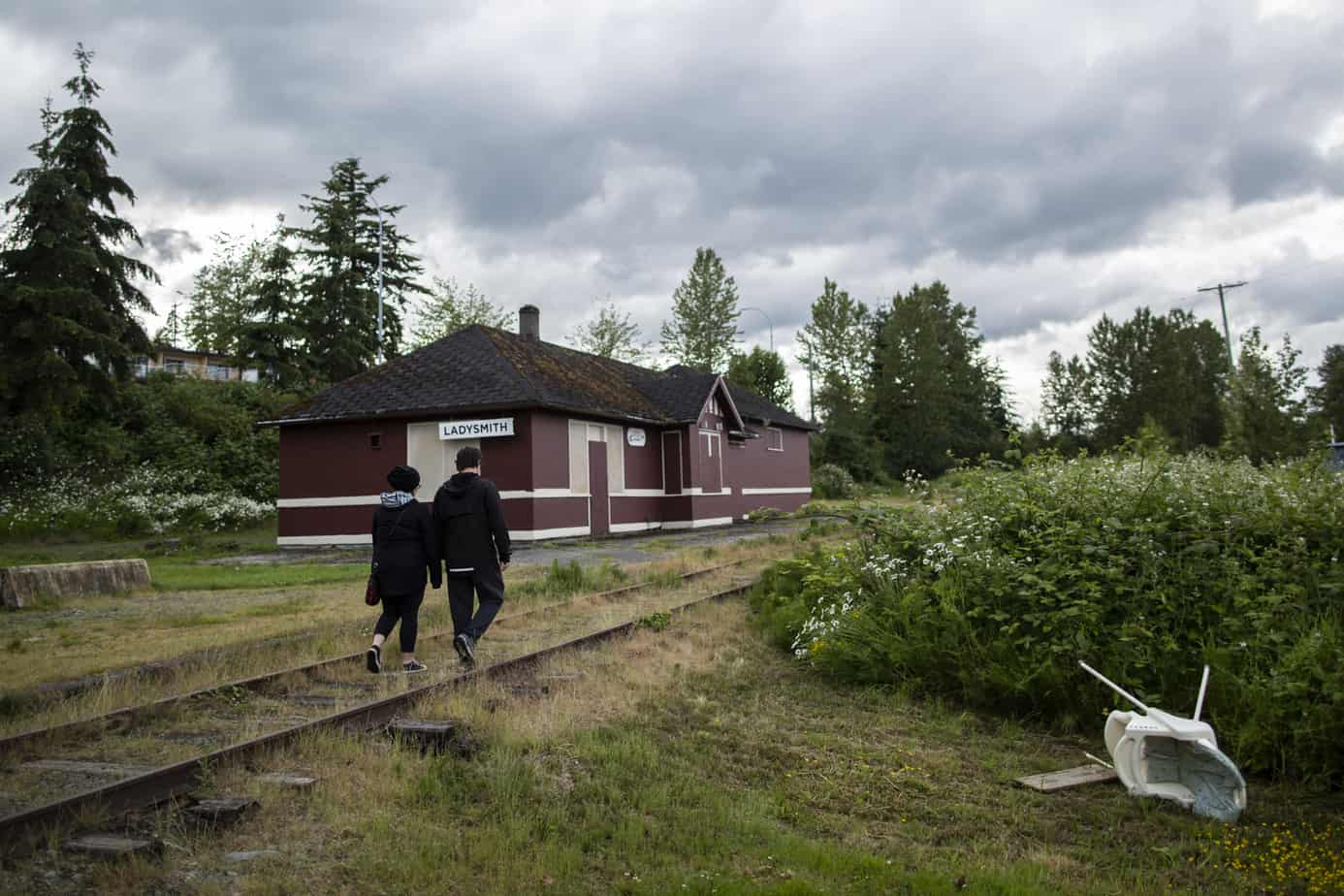
The E&N railway was initially built by white, Chinese and First Nations workers. Some of them were already working in Dunsmuir’s coal mines while others came over after working on the Canadian Pacific Railway line on the mainland.
Construction on the line started in both Nanaimo building south, and Esquimalt building north, and the two lines eventually met in Shawnigan Lake where Prime Minister John A. Macdonald drove in the last spike on Aug. 13, 1881.
Later, the railway was extended to Wellington in 1887, the Victoria harbour in 1888, Port Alberni in 1911, Lake Cowichan in 1912 and Courtenay in 1914. Punjabi workers, many of whom were Sikh, toiled on construction crews expanding the railway in the 1910s.
Private forests, private profits
When the railway was first built there were lumber mills built along the line but it wasn’t until the First World War that the value of logging passed that of coal and mineral mining in B.C.
American logging companies, such as Humbird and Weyerhauser, purchased over 40,000 hectares of E&N railway lands and timber that could be selected at random anywhere in the Cowichan, Chemainus or Nanaimo River valleys and north of the Malahat to Campbell River.
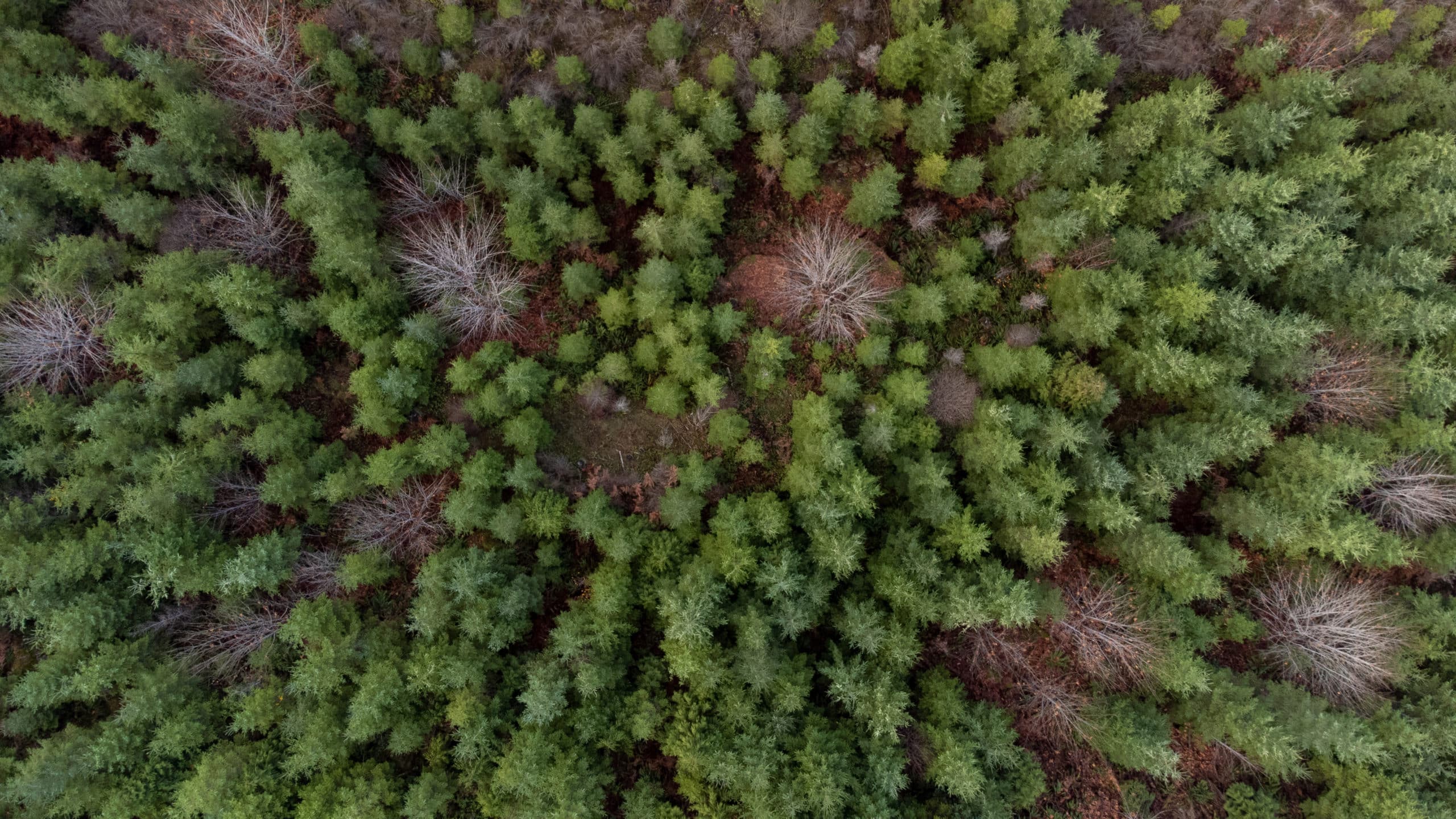
However, it wasn’t until after the Second World War that industrial logging allowed resource extraction to explode on a scale where “trees can be cut down and extracted at a faster rate, and the landscape becomes what we see today with massive clear cuts,” Black said.
“No one ever said to First Nations ‘Hey, things are this way because of the land grants’ and it’s not until much later that First Nations — and non-First Nations [people] — start realizing towards the end of the 20th century that something different is going on in this section of Vancouver Island.”
In the early 2000s, the forestry companies that bought the land were acquired by investment capital firms, including Brookfield Asset Management which created Island Timberlands in 2005.
The British Columbia Investment Management Corporation and Alberta Investment Management Corporation bought large stakes in the new company.
TimberWest was bought out in 2011 by British Columbia Investment Management Corporation and the federal Public Sector Investment Board for over $1 billion.
This purchase sparked a declaration by 15 First Nations on Vancouver Island opposing the sale, including the Snuneymuxw First Nation.
Snuneymuxw Chief Douglas White called the 20,000 hectares of TimberWest lands in the Nanaimo River watershed “a fundamental breach of the Snuneymuxw Douglas Treaty of 1854.”
At the exhibit’s launch, Morales said corporate lands don’t benefit the public and urged government workers who contribute to those pension funds to “raise your voice” about the issue.
“The amount of profit that the companies have made out of this territory was astronomical,” he said. “But none of it has flowed to the First Nations.”
Indigenous resistance to dispossession
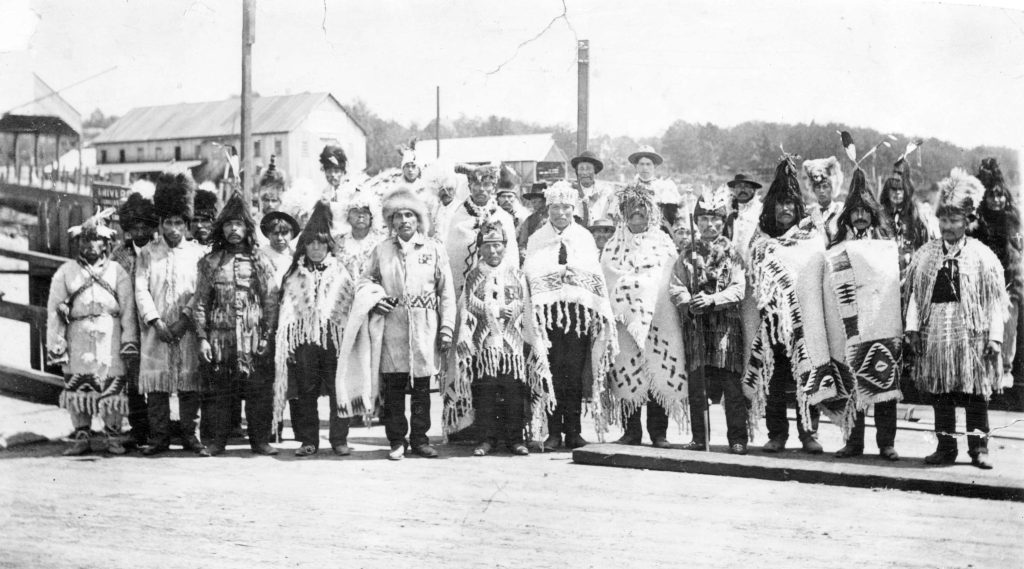
First Nations on Vancouver Island have resisted the dispossession of their lands in their territories since the start of colonization. In 1906, a delegation of First Nations Leaders from Squamish, Cowichan and the Bonaparte nations took their grievances to England to seek an audience with King Edward VII.
In 2007, the Hul’qumi’num Treaty Group went to the Inter-American Commission on Human Rights arguing that Canada “violated the property rights of Hul’qumi’num people by confiscating their traditional lands for the benefit of private third parties” without compensation and by claiming that Aboriginal property rights were extinguished by the nature of the fee-simple grants.
“At a minimum, to make that extinguishment lawful, Canada must provide restitution for the expropriation of those lands belonging to the Hul’qumi’num,” a 2009 petition to the commission said.
The Commission ruled that the petition was admissible but has not made a ruling on the content of the petition.
In 2015, the Snaw-Naw-As (Nanoose) First Nation brought a court case seeking to have the 10 acres of land that was expropriated for the railway through their territory returned. In 2021, the BC Court of Appeals gave Canada and the Province of B.C. 18 months to either support rail service on the line, which stopped in 2010, or return the land. In 2023, the land was returned to the Snaw-Naw-As.
“The end of the film asked how we can now deal with this situation in a positive way without getting angry and throwing out racist remarks and all the rest of that,” Morales said. “We need to find a solution. It was the government that created the problem, the government perpetuates the problem. The government has an obligation to begin to try and resolve the problem.”
Educators and the exhibit
While the primary audience for the exhibit is anyone who lives on Vancouver Island, Black said the project also aims to help educators and students in Grades 10 through 12 learn about the land grant, something he never had the opportunity to do in high school.
The project includes an online learning guide for educators that uses the B.C. curriculum for classes in social studies, B.C. First Peoples, social justice and law studies and provides learning activities for educators to use in their classes.
Black said he hopes educators will talk about the land grant and take their classes to the exhibit to generate conversations about it.
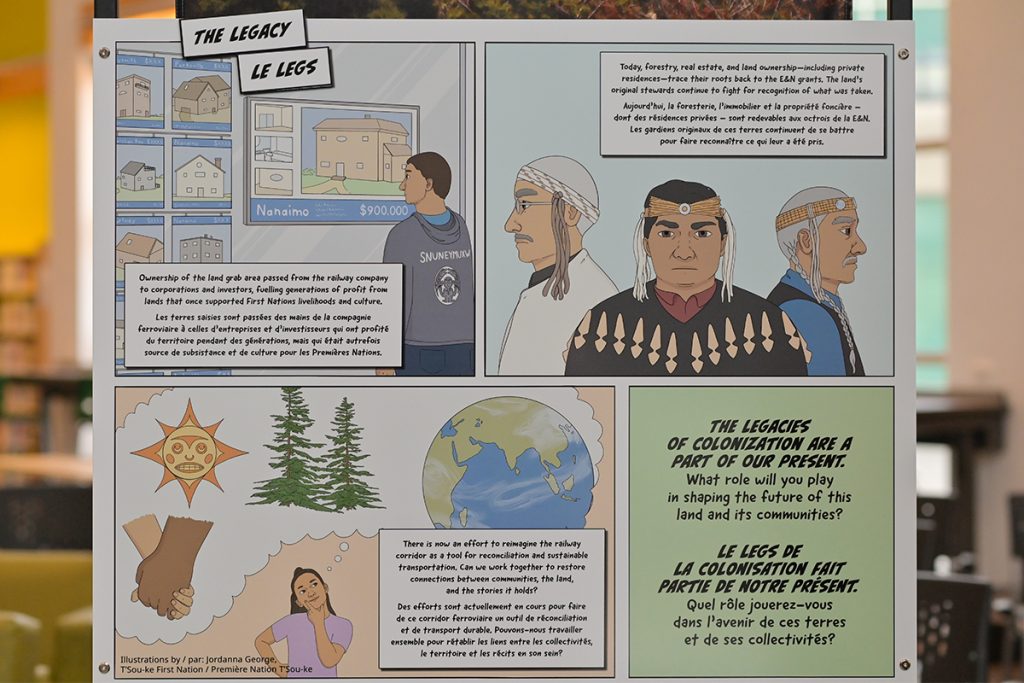
The exhibit also uses graphic-novel style illustrations by Kwakwaka’wakw artist Gord Hill and T’Sou-ke artist Jordanna George. Snuneymuxw artist Eliot White-Hill, Kwulasultun worked on the title and a piece of art that depicts the faces of ancestors descending from the sky onto Te’tuxwtun (Mt. Benson) and a supernatural being representing the energy and spirit of the land.
In his artist statement, Kwulasultun said the artwork “honours the connection we have to place that has been disrupted by the land grab.
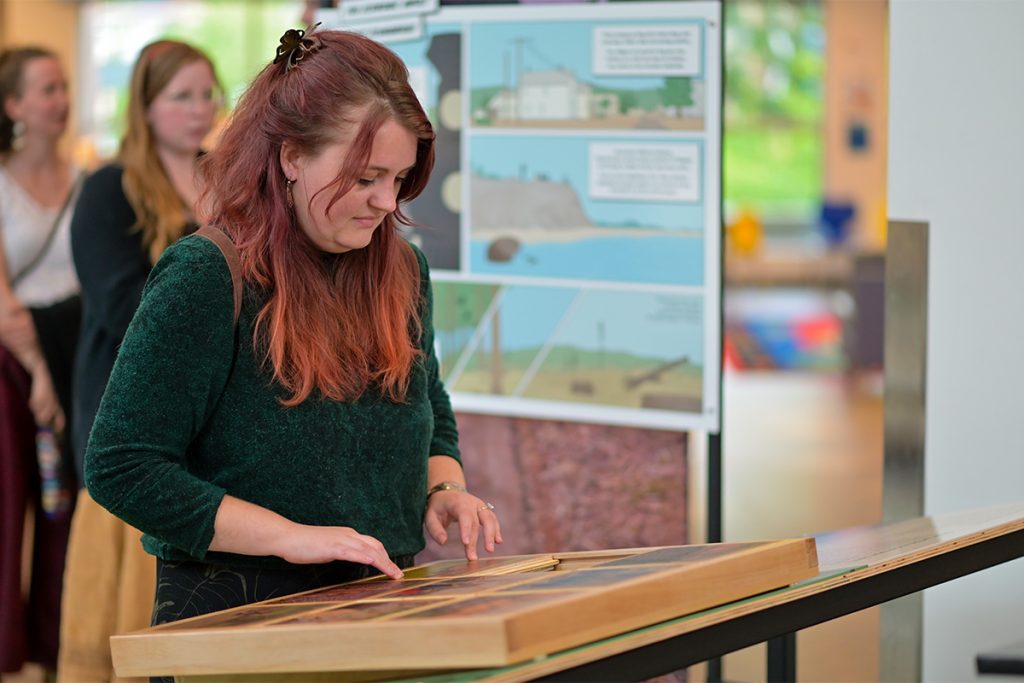
There are also interactive elements of the exhibit such as a three-minute film, a puzzle and wooden blocks that slide up to reveal information. They are designed to engage people who have different learning styles and Black said he hopes people can walk away with the key messages of the exhibit.
The graphic novel style of the illustrations was a deliberate choice as the exhibit is traveling through the Vancouver Island Library system and is meant to be approachable for people of all ages, but especially for teenagers, Black said.
“I’m hoping that people see it as a call to action that now that you know something about this, maybe you can go forward in your life to try and do something about this,” Black said. “I hope that the exhibit is more than just information, that it spurs people into action.”
The exhibit will be on display in the Nanaimo Harbourfront library until Friday, Aug. 15.
What did you think of this story?
Your feedback after we publish a story helps ensure we're always improving our reporting to better serve you
Author
Related Articles
Flooding, wildfires and earthquakes: Can the Comox Valley better prepare for disasters?
After being in an earthquake, Sue Pyper learned a lot. Now she and other local groups are sharing what they learned with neighbours — so everyone can be better prepared.
Remembrance Day 2025 events on Vancouver Island
Events, ceremonies and information on Remembrance Day 2025 in the Comox Valley, Nanaimo and Cowichan Valley
Comox Valley group joins dozens of others in urging province to do more for biodiversity
Save our Forests Team Comox Valley members are not alone in their frustration with the province’s lack of action on old-growth protection.