
Meet the researcher putting Indigenous knowledge at the heart of ecological restoration
For decades, well-intentioned conservationists have been restoring culturally significant Indigenous places without the peoples they belong to. Researcher Jennifer Grenz says that’s exactly why so many of those efforts have failed.
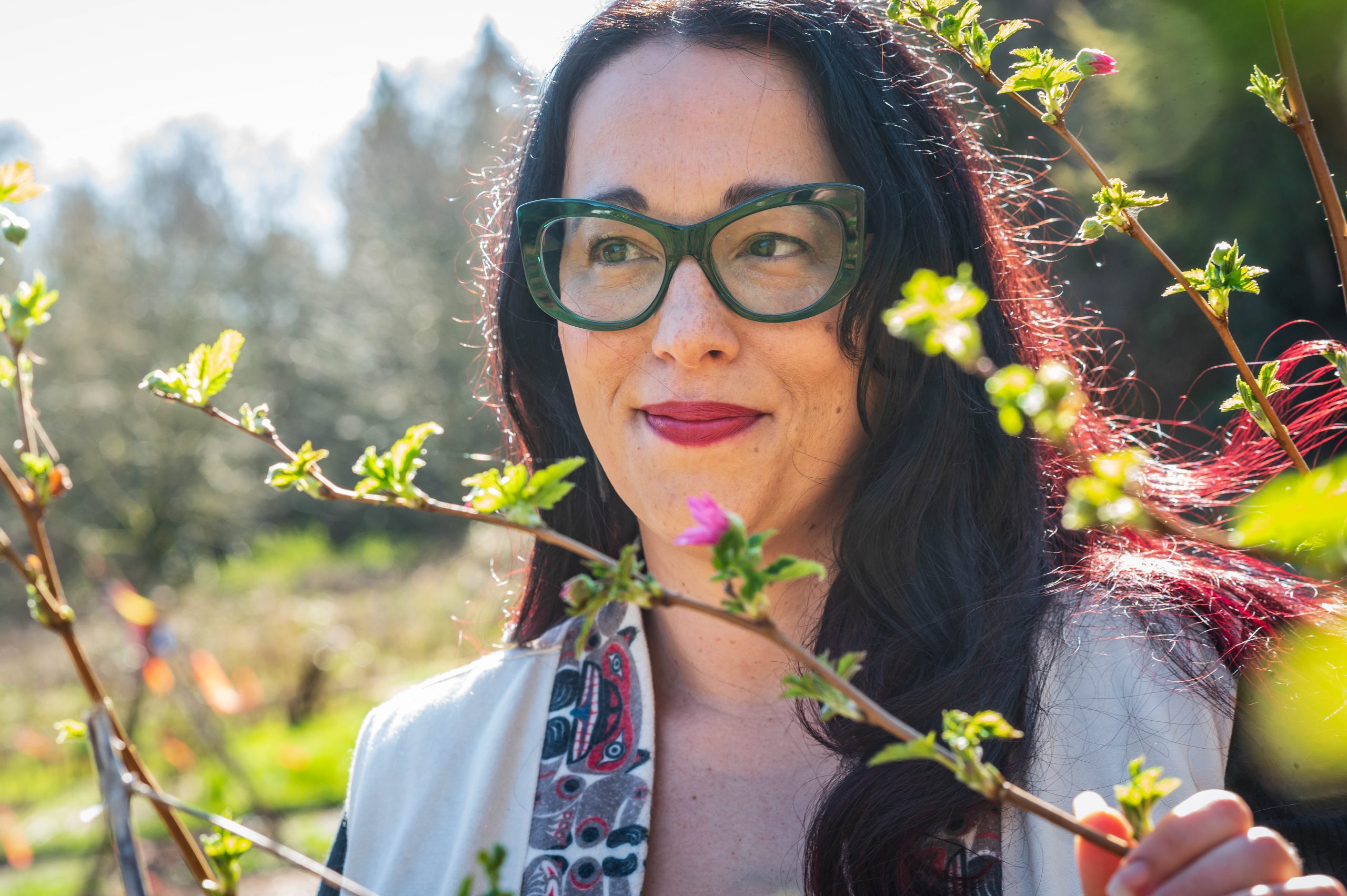
When researcher Jennifer Grenz walks through cedar forests on Vancouver Island, she pictures what the understory would have looked like before settlers arrived.
What used to be a thriving community of edible plants and the animals that depended on them for food has been replaced by ecological silence.
According to Grenz, that emptiness has directly coincided with the decline of Coast Salish hunting practices which kept deer populations in check. This is just one example of how caring for the landscapes of Vancouver Island have become detached from the traditional knowledge of Indigenous people.
Grenz is a Nlaka’pamux woman of mixed ancestry and member of Lytton First Nation. She is a scholar, farmer and head of the Indigenous Ecology Lab at the University of British Columbia where she and her team work with Indigenous communities to heal and reclaim traditional food systems.
She recently contributed to a paper published in Ethnobiology Letters on restoring cultural keystone places which focused on restoring food systems at three sites in the Cowichan Valley: Ye’yumnuts, Hwkw’akw’la’hwum (Cowichan Estuary) and Spune’luxutth (Penelekut) Island.
Grenz said she hopes her research can bring Indigenous ways of knowing and stewardship to the forefront of a field typically dominated by western science.
The Discourse spoke with Grenz to learn more about her research and what she envisions for the future of conservation.
Note: Responses have been lightly edited for grammar and concision.
Eric Richards, The Discourse: Can you describe what a “cultural keystone place” is, and what these three sites — Ye’yumnuts, Hwkw’akw’la’hwum and Spune’luxutth Island — look like today compared to what they once were?
Jennifer Grenz: A cultural keystone place is really where the hub of activity was happening for Indigenous Peoples. These places aren’t defined by their geography (where they are and even the physical features of it), but where people were gathered. There are many examples of activities happening in such places like where they tended gardens, processed foods or gathered for spiritual purposes.
The three sites today have histories where they were a hub for people in villages who were coming and going from travels and growing foods at large scales. Over colonial history, the sites got quiet with the impacts of colonialism. People were displaced from them due to land theft, or people were moved from those lands onto reserves.
If I think about the soundscapes of these places over time, I would say they are getting noisy again as cultural resurgence, and the people of those lands who have been here all along, are working to revitalize these places once more. Spune’luxutth is a bit different as it has largely had a continuous presence.
Read more: What Ye’yumnuts teaches us about ongoing efforts to protect ancient sites
Before this research, what did ecological restoration at these sites look like, and why wasn’t it working — particularly given that many of those earlier efforts were well-intentioned?
Often restoration ecologists or conservation groups would see the remnants of what was there — what I refer to as the legacy state of these places — and misinterpret what was there as them just being locations that have “rare plants” worthy of saving, or calling them “important habitat” for birds or fish. They were unaware of the depth of human relationship that was required to shape these systems over thousands of years.
This misunderstanding, thinking these places were just “natural,” is why we have the failures in restoration we do, because so many of these systems co-evolved with human development and use. For example, plants like camas, admired for its purple flowers, were a critical food source and also important for the trading economy, but needed to be harvested and moved around to thrive. We’re now seeing stressed populations of camas that have become overcrowded after 20 years of successful restoration, but no harvesting.
Your paper mentions “fortress conservation” and the extraction of Indigenous knowledge from its cultural context. Can you explain what both of those things mean in practice, and why they cause harm even when the intention is good?
The conservation movement really has been built around the colonial notion of “naturalness” and that we need to keep people out for nature to be able to do its thing. It is a notion that perpetuates terra nullius, the idea that we, Indigenous peoples within so-called B.C., were hunter-gatherers. This is not true and has been proven by multiple lines of evidence like archaeology, ethnographies and oral histories. We shaped our environments to provide food, medicines and technology.
The abuse of the environment in more recent history has led to a movement that keeps people out to protect it. However, this is stopping access by the people of those lands, and also leads to ecological issues without human intervention. For example, in my own Nlaka’pamux territory, we maintained berry areas for the animals through cultural burning to keep tree canopy open. Now, many of those areas are totally covered by trees and thus, no food for the animals.
Conservation is improving in terms of collaboration with Indigenous communities in some places. But this also can lead to misapplication of our knowledge, peppering it onto systems of land stewardship that are not ours and are not guided by our governance systems. And so they are often not successful long term. Harm can be caused in these processes because the fundamental issues are not addressed, or our knowledge ends up being used without us.
What does “centering cultural resurgence” actually look like on the ground — and how do you measure whether it’s working, given that success here differs from a conventional endangered species checklist?
It looks like gathering many people together in these spaces not just to try and heal them, but to use these spaces as they once were. To be together, to eat, to celebrate, to connect generations together. Things like language and art are integrated into land healing as well. To me, the measure is in how many people are deepening their relationship to the place. So often in restoration we have a handful of the same aging volunteers helping out and again, this is another reason projects fail.
Our success is in creating a context for deepening relationships across generations. We know that people will always care and be there to steward the land. I never learned in ecology courses to host community events and plan feasts, or to spend time with linguists, and now, that is most of what I do and the land is healthier for it.
The connection between Indigenous deer hunting and the health of cedar forests is striking — can you walk us through that relationship?
I think most people on the islands know there is a hyperabundance of deer. They are everywhere. And even in areas with predators, there are still so many that our forest understories do not look like they once did. They should be full of understory species like salmon berry, thimbleberry, red huckleberry and elderberry and in most places all we see is salal and ferns, or just the earth.
Over time, we even think this is normal as we have never seen what it once was. These forests have become almost like biodeserts beneath their canopies as there is no food there, and also no moisture, which is also part of why our forests are drying out and fire risk is increasing.
The photos from our study on Spune’luxutth, where deer populations have been controlled through hunting, make it clear that what we see today on the other islands isn’t normal at all. These forest understories are full of healthy shrub life, and the air is moist. Again, this is an example where just leaving nature be is against many fundamental laws of different Indigenous nations, as we have responsibilities to provide a desired balance and protect all relations — plants, animals and people.
Through hunting, we can limit the numbers which allows the plants a chance to thrive and feed us and other animals and birds and insects. Without it, not only is the forest suffering, but the deer are too as there is less food for them.
Your paper suggests that strengthening human relationships to land — not just for Indigenous peoples but for non-Indigenous people too — is essential for long-term ecological health. What do you think that will look like for settler communities in the Cowichan Valley?
I think this is about people coming together to care for lands where they live and seeking reciprocal relationships. Where it isn’t just coming to protect something, but perhaps it is also getting some food in return. I would love to see the development of something like food tenures. We have forest tenures, why can’t taxpayers have the right to build their own forest gardens where they steward the land and also get food back to feed their families? Especially in a time when there is a food security crisis. I also see these places being created that are not only healing land, but becoming neighbourhood hubs and gathering spaces. We need to bring these spaces right into communities.
I found this paper to be very personal for a scientific article. What has this work changed in how you see your own relationship to land — and what do you hope a reader who knows nothing about this research takes away from it?
It is a very different type of paper for a standard academic article, which is why we are so proud of it. The idea of being objective in science isn’t real. We are all motivated by something, often something we care about when we choose a career path. We also often don’t share our own experiences in science and I think perhaps this is why there is skepticism toward scientists.
We wanted to share, honestly, our own evolutions as humans and as scientists in restoration ecology and conservation. Also, this is what it is to embrace Indigenous research methodologies, where the researcher is supposed to be inside the research because you are accountable to the place and people you are working with. As an Indigenous scholar, I finally feel free to be myself, to bring my worldview and knowledge into my work. And I think non-Indigenous researchers are also benefiting from being able to do this too. I will never see land without people.
I will always think about the relationships which created the place I am working on over thousands of years and I will always be working to bring people, no matter who they are, onto the land and encourage them to deepen their relationship with it.
I really hope that we have humanized science and that people see the places they go to everyday a bit differently, perhaps with wonder of how it was shaped to be as it is today.
You describe a moment watching Quw’utsun people hold their first feast on the land at Hwkw’akw’la’hwum in over 100 years — what was that like for you personally?
I sat beside an Elder who already changed my life by so generously sharing his knowledge with me over the past almost 10 years now, Dr. Arvid Charlie, Luschiim.
I watched him eat his clams beside the fire, and the potatoes that Qwustenuxun (Jared Williams) cooked in a bentwood box, and I listened to all of the other people eating and chatting and looked at the beginning of our plant nursery being built by the Nature Trust of BC.
I felt a peace in my heart that I have rarely felt before in any restoration project, where usually I feel worried for what the future would be. But I just know that this place, this cultural keystone place of the Quw’utsun People, will be ok, forever.
What did you think of this story?
Your feedback after we publish a story helps ensure we're always improving our reporting to better serve you
Author
Related Articles
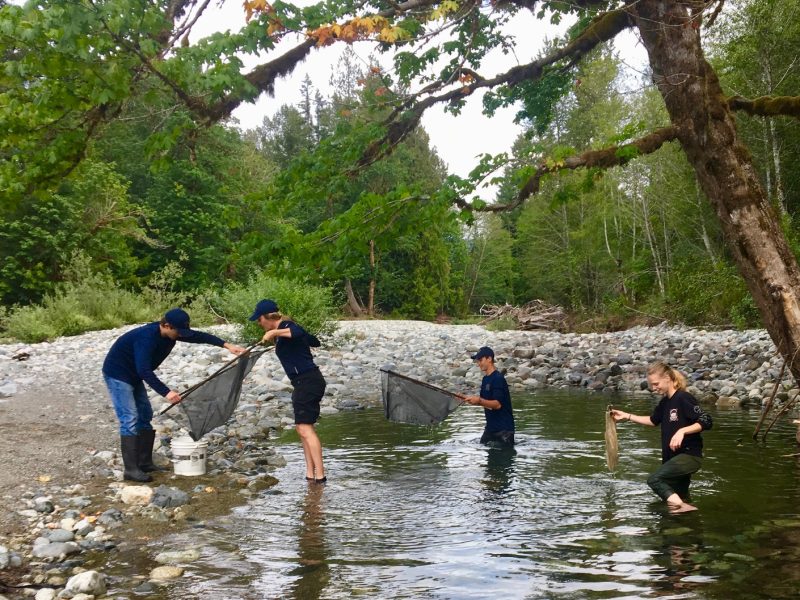
What to do and who to call when juvenile salmon are in danger
Officials say Cowichan Valley residents should call experts to move salmon in isolated pools because of risks associated with relocation.
How is The Discourse’s journalism funded?
And what does it cost to produce The Discourse’s in-depth, independent journalism?
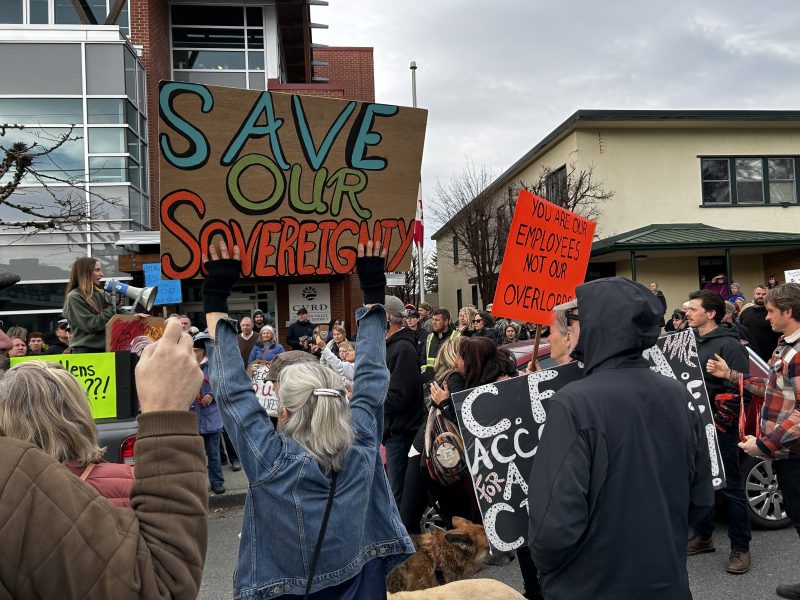
Behind the backlash to the Cowichan Valley’s comprehensive zoning bylaw
The campaign against Bylaw 4710 was fuelled, in part, by misinformation and an organized group of advocates. What could this mean for the future of local politics?