
How the NDP lost Vancouver Island
Former Vancouver Island NDP MPs and activists on why they lost and how they want to rebuild the party.
Editor’s note May 10, 2025: This story was updated with a response from a local Green Party volunteer about its use of local polling.
Former New Democrat MP for Nanaimo—Ladysmith Lisa Marie Barron was choking back tears on the same day she packed up her constituency office. The federal election results were determined about a week prior, and after four years of representing her constituents, Barron had lost her seat to the Conservative’s Tamara Kronis.
“I’m worried about all the people on the streets. I’m worried about the people dying from the toxic substances. I’m worried about our climate and to see now us being represented by a Conservative is heartbreaking,” Barron said. “It’s the worst case scenario for me.”
The riding, newly formed in 2015, had yet to see a Conservative member of parliament until this year, and it’s not the only riding on Vancouver Island where the NDP lost seats.
The 2025 federal election saw the NDP go from holding six seats on Vancouver Island to just one in Courtenay—Alberni, while the Conservative Party of Canada won three seats and the Liberal Party of Canada picked up two seats in the Greater Victoria Area. Green Party Leader Elizabeth May held on to her seat as the lone Green MP in Saanich and the Gulf Islands.
There isn’t a single reason why the NDP saw such losses on the Island, and experts and politicians suggest several outside forces and factors contributed to them, including growing political divides, influence from polls and strategic voting.
“The NDP really has a challenge here,” said Dr. Michael MacKenzie, Jarislowsky Chair in Trust and Political Leadership at Vancouver Island University’s political studies department. “They have to win back its traditional working class support base, but also the professional classes that have often supported the NDP. They need to convince people that they’re different from the Liberals and I think that’s a challenge.”
‘Dramatic changes’ on Vancouver Island
The NDP losses on Vancouver Island were part of a broader collapse of the NDP vote nation-wide, with the party winning just seven seats and 6.3 per cent of the popular vote. It was the worst showing in party history and a long way from the 2011 election when the party won 103 seats and became the Official Opposition.
MacKenzie said that Vancouver Island has always been politically divided.
“There’s always been a competitive conservative candidate in each riding on Vancouver Island, they’ve always had a constituency,” he said. “What we’re seeing is a pretty small shift in the vote leading to some pretty dramatic changes in the colour of the Island.”
In Cowichan—Malahat—Langford, Conservative candidate Jeff Kible won 37.2 per cent of the vote, beating three-term NDP MP Alistair MacGregor by 4.6 percentage points, or 3,544 votes. LIberal candidate Blair Herbert got 28.2% of the vote while Green Party candidate Kathleen Code won two per cent of the vote.
In Nanaimo—Ladysmith, the Conservative candidate Tamara Kronis won with 35.5 per cent of the vote, followed by Liberal candidate Michelle Corfield with 27.8 per cent and the NDP and Greens in a statistical tie at 18.3 and 18.1 per cent, respectively.
The Conservatives gained 8.6 percentage points more of the vote in Nanaimo—Ladysmith compared to 2021, while the People’s Party of Canada (PPC) only managed to win 289 votes or 0.4 per cent of vote, down from five per cent in the previous election.
“I think the Conservative Party has moved quite far to the right. At least the rhetoric of Poilievre’s campaign was to the right of O’Toole’s and that was PPC territory, so I think it’s reasonable to think that some of those voters probably went Conservative this time,” MacKenzie said.
Barron said Poilievre’s leadership was a reason why the NDP caucus decided not to trigger an election in the fall, when the NDP seemed poised to return to being the Official Opposition.
“I never thought I’d ever say I miss Erin O’Toole, but Pierre Poilievre is a man that we need to beware of,” she said. “He’s a bully, and he does not have the best interest of Canadians at the forefront. We see this in everything that he does.”
She said, “at that point in time, there is just no way that I would take part in allowing a Conservative government to have power” calling it a “challenging decision” for the NDP.
Alistair MacGregor, former NDP MP for Cowichan—Malahat—Langford, said that the possibility of a Conservative majority under Poilievre would have “rolled back so many of the things that we had spent so much time fighting for.”
Pushing polls and strategic voting
Barron blamed the Green Party for pushing polls — paid for by the party — that sowed confusion during the election about what candidate was the best choice to defeat the Conservatives.
She wants Elections Canada to examine if polls paid for by political parties that are used in elections advertising should have to provide information such as how many people were reached, what all of the questions were and what level of responsibility parties have to make sure that the methodology used for the polls is clear to voters.
During the election, both the Greens and the Liberals published polls at different times claiming they were in second place to the Conservatives.
“We didn’t do a poll, even though I kept being accused of having done a poll that I’m hiding, I’ve never done a poll,” Barron said. “In order to actually create a representative poll that will give any sort of information that’s relevant to voters, it would cost a lot of money and take a lot of time, and then the moment that I publish it, it’s out of date.”
MacKenzie called the practice of parties paying for local polling “a bit questionable,” agreeing that people “need to know a lot about how a poll is conducted, and there’s always an incentive for a company that’s working for a party to make the party look good.”
Josh Rudolph, who volunteered on Manly’s campaign, said the Green’s poll was “professionally conducted and released to the media with full methodology” and criticized an NDP mailer that “displayed 2021 results in a format that looked like current polling, and even circulated an Island-wide mailer that omitted the Greens entirely—disingenuous, given that Vancouver Island has the highest Green support per capita in the country.”
He said that was “far more misleading than sharing fresh, methodologically sound data.”
The NDP and the Labour movement
One aspect of the election was the alienation of workers from the NDP, pushing them to the Conservative Party.
A poll done by Abacus Data in summer 2024 already pointed to problems for the NDP, with 47 per cent of people who self-identified as working class saying they would vote Conservative compared to 20 per cent who said they would vote NDP. The NDP had its strongest support among people who said they grew up lower-class at 33 per cent, but even then the Conservatives enjoyed 32 per cent support.
“The Conservatives have found a way to pick up a lot of the working class vote, or at least that’s what seems to be happening,” MacKenzie said.
Barron said the party needs to reconnect with its traditional blue collar roots.
“There’s still a lot of support, in particular here in and in Ladysmith, but across the country there’s undoubtedly a lot of work that needs to happen to rebuild those relationships and make sure that labour, workers and people in our communities know that we’re there fighting for them,” she said. “If there’s ever a strike, the NDP is the only party that shows up and is standing up for workers. It’s just getting that messaging out.”
Joanna Lord, a trade unionist with the BC General Employees Union in the Cowhican Valley, is a die-hard NDP supporter but acknowledges that more private sector unions — particularly those in the building trades in Ontario — have moved away from supporting the NDP and are increasingly backing the Liberal or even Conservative parties.
“I don’t think that is as much the case here in B.C. and I definitely don’t think it’s the case for the labor unions who are part of the BC Federation of Labour,” she told The Discourse.
According to the Conservative Party website, there were a total of one national union and eight union locals that endorsed the party including the International Brotherhood of Boilermakers Canada and a mix of other building trades locals from the Carpenters, electrical workers, Steelworkers, plumbers, and painters unions.
“I think those are really big warning signs that the NDP risked losing its sort of position as the natural party of labor in this country,” said social studies teacher and content creator Steve Boutilier, who goes by Steve Boots online. “I think they still are, but I think there are huge warning signs that they could lose that position if they don’t make some pretty significant changes.”
Boutilier’s work consists of daily live streams where he covers political news of the day, party announcements or explainers on the various party platforms during the election. He said there is a big appetite for content covering Canadian politics on TikTok and YouTube, especially from a leftist perspective.
“It just needs to be packaged in a way that makes sense to people,” he said.
He thinks the NDP needs to take “stronger, more socialist positions” and talk about public ownership, raising class consciousness and protections for workers.
“There are lots of different approaches that they can take to stake out that position and defend it, rather than sort of chasing those voters in the mushy middle,” he said.
Is Canada moving toward a two-party system?
MacKenzie doesn’t think that the collapse of the NDP, Green and PPC vote means that Canada is heading towards a two-party system.
“Some people said this in 2011 when the NDP won big,” he said. “We thought we were maybe moving to a British system where we had a Labour Party in the form of the NDP and a Conservative Party, and that those would occupy the left and right respectively and there would be little to no presence in the middle of the political spectrum.”
This didn’t happen with the Liberal Party of Canada, under former Prime Minister Justin Trudeau, winning a strong majority in 2015.
“To be frank, Mark Carney’s run is probably right of Trudeau — he’s very much in the centre, probably the centre-right,” MacKenzie said.
This raises the question of if the framing around splitting the progressive vote is accurate, or if it should be seen more as a collapse of the progressive parties with the two main parties Canadians voted for being centre-right and ardently conservative.
Barron, who introduced a motion to create a national citizen’s assembly on electoral reform in 2023, said she doesn’t want to see a two-party system develop in Canada.
“I do not want to see a two-party system like we see in the United States,” she said. “We know that we need to have more NDP in government, holding to account both the Liberals and Conservatives, to see actual programs and services being delivered for Canadians, to see the ultra rich paying their fair share.”
The question of leadership for the NDP
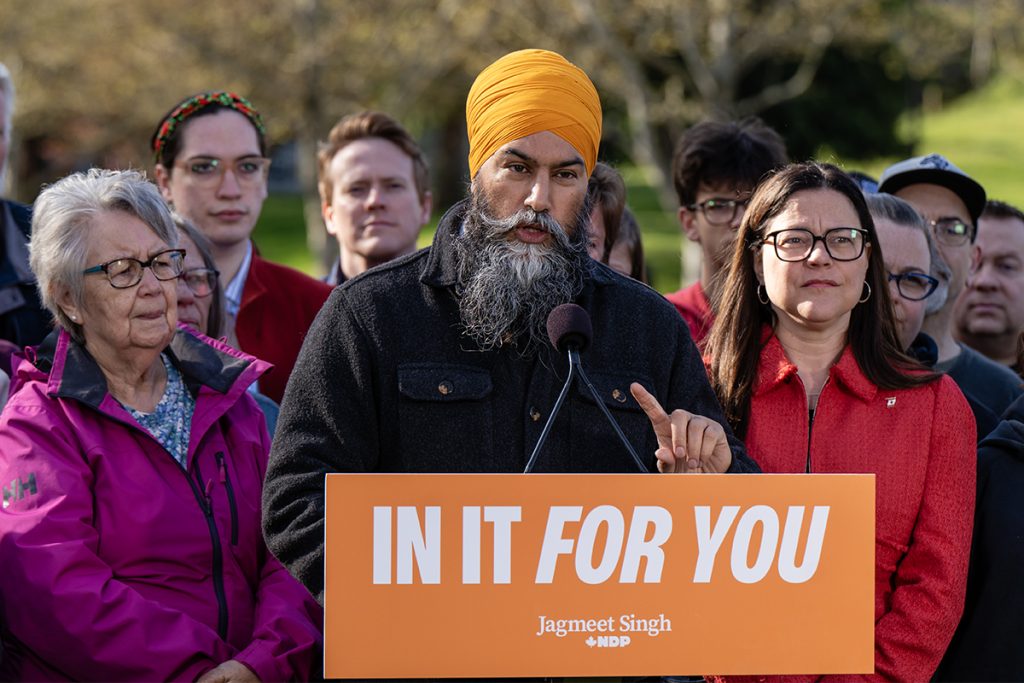
NDP Leader Jagmeet Singh resigned on election night after conceding the race in his own riding in Burnaby Central, where he placed third with 18.2 per cent of the vote.
While Barron wouldn’t talk about who she would like to see run for the NDP leadership, she said that the qualities she’s looking for in a leader is someone who “people feel is authentic, that people can connect with and that understands what it’s like to be in the community, working paycheque to paycheque.”
Boutilier said the NDP caucus being leveled to just seven MPs doesn’t leave a lot of room for leadership hopefuls. He points to Heather McPherson from Edmonton Strathcona as a “very strong candidate” while he thinks Don Davies, who has been selected as interim leader, is a good fit for that job.
He raised the idea of Daniel Blaikie, who is now working as chief of staff for Manitoba Premier Wab Kinew, as another potential leadership candidate.
“The few NDP MPs that are there are going to, I know, kick ass and keep on fighting for what’s right,” Barron said.
Conservatives who skipped debates and ignored media face an “uphill battle”
During the campaign, Conservative candidates skipped all-candidates meetings in Nanaimo—Ladysmith and Cowichan—Malahat—Langford. There was also controversy after an all-candidates debate in the North Island—Powell River riding was cancelled half an hour before its scheduled start.
Conservative candidates also did not respond to media requests, including several made by reporters at The Discourse, during the campaign.
“I’m deeply worried about a major party systematically disengaging with citizens during a campaign, and I think that’s what we saw from the Conservatives,” said MacKenzie, who moderated the candidates forum at Vancouver Island University that went ahead without Kronis.
“I suspect Tamara Kronis genuinely wants to engage with the citizens of Nanaimo—Ladysmith, and I suspect she probably genuinely wants to listen to people’s concerns,” he said. “But there’s a majority of people who live here who feel like she was disengaged and not listening during the campaign, and that’s going to be an uphill battle for her, to be honest.”
With files from Eric Richards.
What did you think of this story?
Your feedback after we publish a story helps ensure we're always improving our reporting to better serve you
Author

Related Articles
Comox Valley, Nanaimo land trusts raising funds to support Deep Bay land conservation purchase
In a partnership with the Comox Valley and Nanaimo Area land trusts, BC Parks Foundation is fundraising to protect 50 hectares of pristine shoreline in Deep Bay and make it accessible to the public.

Nanaimo Jazz Festival celebrates 10 years with more than a dozen shows in September
Local and international artists to perform on multiple stages in the city at this year’s Nanaimo Jazz Festival.
Snuneymuxw Elder C’tasi:a shares traditional plant knowledge in new book
‘Plant Teachings from my Auntie’ by Snuneymuxw Elder C’tasi:a and ethnobotanist Nancy Turner delves into traditional plants and plant medicine.