
Q&A: Nanaimo’s poet laureate Neil Surkan on the radical act of reflection
Surkan explains how Nanaimo’s outdoors inform his poetry and his goal as the new poet laureate for 2024-2026.
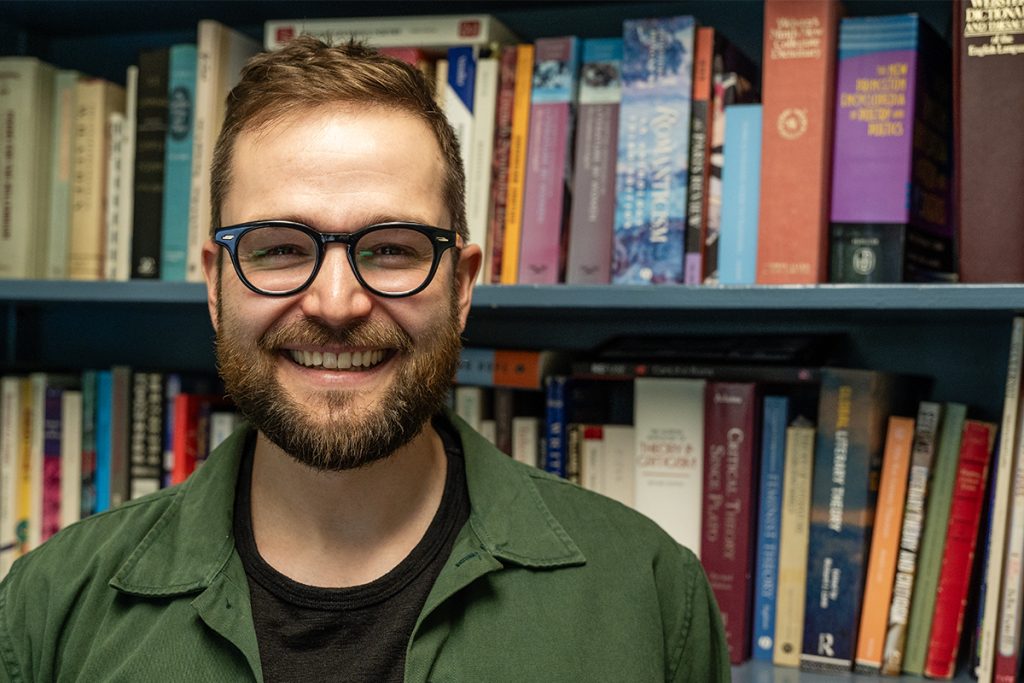
Neil Surkan, the City of Nanaimo’s new poet laureate for 2024-2026, says he is still working on finding his place in the city and that this role is part of that process.
Surkan moved to Nanaimo in 2021 with his family when he got a job teaching English at Vancouver Island University. He applied for the position as the city’s poet laureate as a way to help build a deeper connection with the city.
“The reason that I was interested in this role was I love being here,” he said. “I love this teaching role and it’s easy to just have a little circuit between work and home and parenting. I just wanted to be a little more community facing. The community here feels really strong and I wanted to go beyond those bounds a little bit.”
Nanaimo Mayor Leonard Krog said he was “delighted” to welcome Surkan to the position.
“The extraordinary passion, talent and experience our newest poet laureate brings to this role is sure to inspire,” Krog said in a press release. “We look forward to all the ways Mr. Surkan will engage the community, sharing the power of words through poetry and further enriching our thriving cultural lives!”
I sat down with Surkan in his office at Vancouver Island University to chat more about his work and what he hopes to do as Nanaimo’s poet laureate.
Q. For people who are not in the poetry world, how would you explain what you do to them?
The way that I’ve always defined a poem is that I like to think of poems as events in language. That comes from the poet Ben Lerner, when you think of the poem as just an occasion that begins and ends with the words that we use in our day-to-day lives.
What I think is super important about poetry is that it draws us into how fragile everything we say to one another is in terms of interpretation, misinterpretation, misapprehension. The possibilities for confusion are so high anytime that we speak. And I think that sensitivity to how strange it is that we communicate to one another this way, both face-to-face or on the page, is central to the art form.
It’s strange to be human. It’s mysterious. And our words actually invite us to think about that, whether we’re aware of it or not. So the example I give is the next time you say, “I love you” to someone, consider how the possibilities for misinterpretation are so high, and yet how so often a moment of connection comes true. It’s that precarity where the poem resides, the possibility of rejection, of betrayal, of heartbreak, and also the possibility of wonder and true compassion.
Q. Is there anything particular you plan to write about in terms of the city?
The city is already trickling into this new manuscript. I’m a poet who likes to draft a lot, and if I’m not feeling surprised or also a little bit bewildered by my own work as it kind of unfolds, I tend to find that maybe those poems have hit dead ends. So it’s always tricky to kind of think about a civic position. I’m so excited about that interplay of just being. I love to follow the language where it leads. I especially like just being outside in Nanaimo, just kind of letting conversations and happenstance interactions trickle into the poem.
That’s already there in a lot of my work, but I’m hoping that this role just kind of helps me to focus those events a little bit more in specific places I’ve already written about. Piper’s Lagoon sneaks in. There’s this little bluff up by Westwood Lake that I love to run to all the time, called Moon Rock Bluff. It’s just written on a little piece of cardboard or something nailed to a tree. I love that place. So these ideas of just being in place and being together.
Harbours are going to be important. I love the dual nature of this idea of a place of respite from storms or a place of coalescence as the harbour, but also this idea of harbouring a sentiment or a feeling or a secret, this idea of carrying something within us. So how we harbour things into a harbour space is going to be central to a suite that I’m starting to craft. I say all that with the uneasiness about articulating what the poem is going to be before I write the poem. I don’t want to curtail the possibilities.
Q. You mentioned earlier that a lot of your time is spent parenting and I think you may write about this as well?
The role of parenthood in my poems right now is kind of twofold. One, being a dad makes me speak more frankly in my poems, right? So this idea of slyness was really fascinating to me as a younger writer, and now there just seems to be something more at stake in terms of the way I wield language. So maybe there’s a different kind of confidence in the language there that just comes from being seen by someone that I deeply admire and also have to guide through the world, my kid. Climate change and the sense of precarity in the world is really central to my current poems, specifically thinking about the idea of becoming an ancestor to someone else, so having a different stake or a sense of accountability toward the future.
We’re in this place that verges on wood, verges on ocean and there’s a really fraught history, a very particular history. Then a bomb cyclone ripped some of the parts of the siding off my house last week. These are new pieces of environmental energy that are shifting, and so there seems to be a different kind of urgency around parenting. Talking to other parents, I really noticed that. That sense of looking for something to kind of find solace in. And so I’ve been thinking a lot about certainty versus precarity, and how I can just lean into the fact that lives are finite anyway. That’s a very dire thing to say as a poet laureate.
Q. What are your plans for future events as the poet laureate?
One of my goals is to have a space where we can reflect on the poems that we’re about to hear together first. That’s something I’ve always been kind of curious about. What if we had a workshop or a little close reading practice for 30 or 40 minutes before the reading starts, and then we transitioned over to hear the poets themselves in their own words? To think about the impact of the language we’re hearing in our own lives and our own mysteries and contexts. That’s my dream. I’m hoping that we can make that happen. The city also has really beautiful spaces to hear readings, our library spaces in particular, I think it would just be so cool to have regular hubs for people to come and encounter new language.
Q. What do you think the importance of the arts is for the city?
I think that now more than ever we need the arts. I think that can have political valences, climate valences, spiritual valences. But I think that the arts right now are just so crucial to us at this time, because so much of the world feels like it is changing really rapidly. And the place of the poet, the place of the visual artist, the place of the musician is to still invite us to savour the strangeness or even the scary parts.
Q. One thing you told me is that you are interested in putting poetry prompts around the city in places where people gather. Can you tell me what that would look like?
I think it will be really simple. It’s just one word for what you hear right now, what you see right now. One word for the sensation in your fingers. One word for what you know about this place in terms of its history, one word for the sensation of the breeze on your face.
Often all we need to kind of just enter into a more complex relationship with the words that we use, and also just with ourselves in the present. I feel like post-COVID, the world just is sliding by so fast sometimes. It feels like I’ll jump ahead a week and realize that I’ve done something, but missed a bunch of time. I think that’s where the language of the poem, or this idea of poetic thinking, can kind of just slow us down and offer us a space to reflect. Reflecting, in this day and age, is a radical act.
Surkan will be joining Nanaimo’s youth poet laureate Paige Pierce’s Holiday Poetry Showcase on Thursday, Dec. 5 at the Nanaimo Harbourfront library at 6 p.m.
What did you think of this story?
Your feedback after we publish a story helps ensure we're always improving our reporting to better serve you
Author
Related Articles
Nanaimo mayoral candidates address the homelessness crisis
Homelessness is a key election issue but what can the City of Nanaimo do about it?
How Nanaimo candidates would pay for rising infrastructure costs
City of Nanaimo’s 2026 candidates share how they’d manage the budget to cover rising infrastructure and repair costs without overburdening taxpayers.
Nanaimo candidates on how the city can cut emissions
City of Nanaimo’s 2026 candidates share two actions within city jurisdiction they’d prioritize to reduce emissions, and how they’d know if they were working.